The app reviews told us what to make
How we grew Knowunity with student creators on TikTok
September 2023
When I joined Knowunity, we were struggling to get the UK market moving.
Other markets were growing, but the UK was stuck at around 100 daily downloads.
We were running ads, working with creators, and doing most of the things you’d expect from a growth team launching in a new market.
But the numbers weren’t moving.
I remember going through our app store reviews to understand what students actually thought about the product.
And that’s where things started to make sense.
A lot of students were downloading Knowunity for one specific reason: they needed help preparing for exams.
We had launched right in the middle of exam season, but our marketing wasn’t really speaking to that. We were promoting Knowunity as a general study app when students were looking for something much more immediate.
They wanted help with their GCSEs, A-levels, mock exams, and last-minute revision.
So we changed our approach.
Instead of talking about everything Knowunity could do, we started creating content around the problems students were dealing with at that moment.
The results were pretty significant.
Daily downloads went from around 100 to roughly 2,400.
That experience changed how I approached growth for the rest of my time at Knowunity.
We stopped starting with what we wanted to tell students and started with what students were already telling us.
Turning student feedback into a creative strategy
One good insight can unlock growth. But we needed a way to find those insights consistently, especially as we expanded across different markets.
So we built a simple research process.
For every market, we maintained a sheet where we collected feedback from app reviews, student interviews, and our own data.
Nothing particularly sophisticated.
We documented what students were saying, what problem they were trying to solve, and how we could translate that into content.
We also looked at how those insights could improve our app store messaging.
Over time, we started grouping the feedback into what we called messaging buckets.
Each bucket represented a different reason someone might want to use Knowunity.
| Messaging bucket | Student insight | Example video hook |
|---|---|---|
| Exams | I need to revise and I’m running out of time | "If you’re studying for your GCSEs or A-levels, I’m about to practically hand you an A-star." |
| Save time | Homework takes forever | "The quickest way to prepare for exams or finish a homework assignment." |
| Better notes | I don’t know which notes to trust | "Still begging your classmates to take a picture of their notes?" |
| Funny / drama | Entertainment and relatable school situations | "POV: the pick me girl sits next to the nerd." |
| School life | School is stressful | "How am I going to finally have a good school year?" |
The funny/drama bucket was slightly different. It didn’t come directly from a product problem. We included it because we knew entertainment was a big part of why students opened TikTok in the first place.
These buckets became the foundation of our creative testing.
Rather than asking creators to make random videos about Knowunity, we could give them a specific angle to work with.
And every week, we tested different buckets against each other.
The videos getting the most clicks weren’t always driving the most installs
One of the more interesting things we discovered was that engagement didn’t always translate into installs.
Here’s an example from six weeks of testing in the UK.
| Messaging bucket | Videos | Installs | Click rate | Cost per install |
|---|---|---|---|---|
| Exams | 5 | 19,972 | ~1.0% | ~€1.09 |
| Funny / drama | 2 | 5,777 | 1.5% | ~€2.29 |
| School life | 1 | 999 | 1.3% | €7.25 |
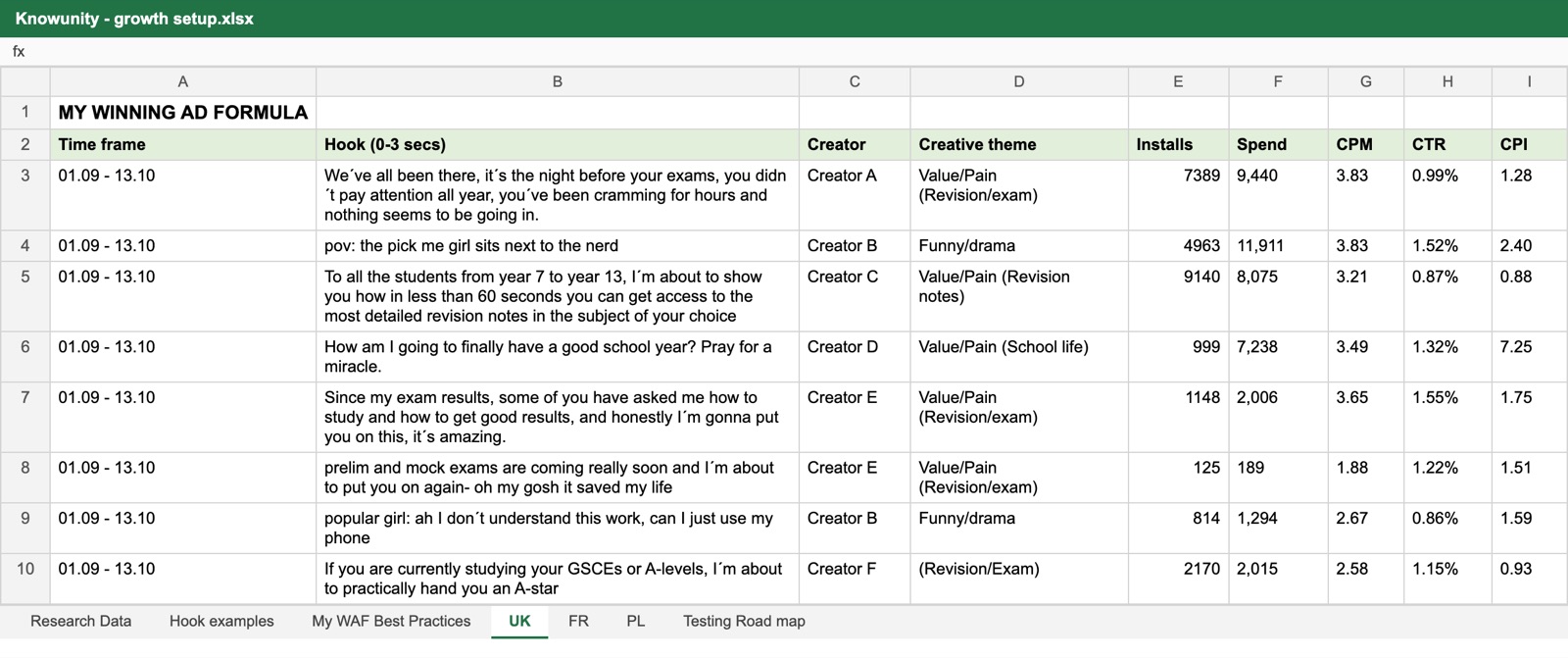
At first glance, the funny videos looked promising.
They had the highest click-through rate.
But when we looked at installs, the picture changed.
The exam-focused videos were bringing in students at less than half the cost.
It made sense when you thought about it.
Someone might click on a funny school video because it’s entertaining. But a student with an exam coming up has a much stronger reason to download an app that can help them prepare.
Our best-performing video during that period wasn’t particularly creative in the traditional sense.
No elaborate editing. No trending joke.
Just a student explaining how to get free revision notes for almost any subject in under a minute.
That single video generated over 9,000 installs at less than €1 per install.
It reinforced something we kept seeing: the strongest creative wasn’t necessarily the most entertaining. It was the one that connected a real student problem to a useful solution.
Why student creators became central to our growth
Knowunity’s audience was primarily students between 11 and 18 years old.
And one thing became clear pretty quickly.
Students didn’t want to hear a brand explain why they should download a study app.
They were much more interested in hearing from other students.
So creator-led content became the foundation of our TikTok growth strategy.
We worked with students who were already creating content about studying, school life, exam preparation, and the everyday experiences of being a student.
The goal wasn’t to turn them into traditional advertisers.
We wanted Knowunity to appear naturally in the kind of content their audiences were already watching.
We generally worked with two groups of creators.
| Micro creators | Macro creators | |
|---|---|---|
| Audience size | Roughly 10k–100k followers | 100k+ followers |
| Creator profile | Students sharing relatable school and study content | Larger study and school-focused accounts |
| Main role | Content volume, hook testing, and creative experimentation | Reach, market launches, and scaling proven messages |
Micro creators were particularly useful because they allowed us to test many different ideas without committing large budgets to a single creative direction.
Macro creators helped us get more reach when we had a message that was already working.
But there was something else we had to get right.
We couldn’t over-script the creators.
We learned that the hard way.
Whenever we tried to control too much of what a creator said, the content started feeling like an advertisement.
And that usually showed up in the performance.
So we changed how we briefed them.
We provided the messaging bucket, the problem we wanted to address, and a suggested hook.
Then we let the creators communicate it in their own style.
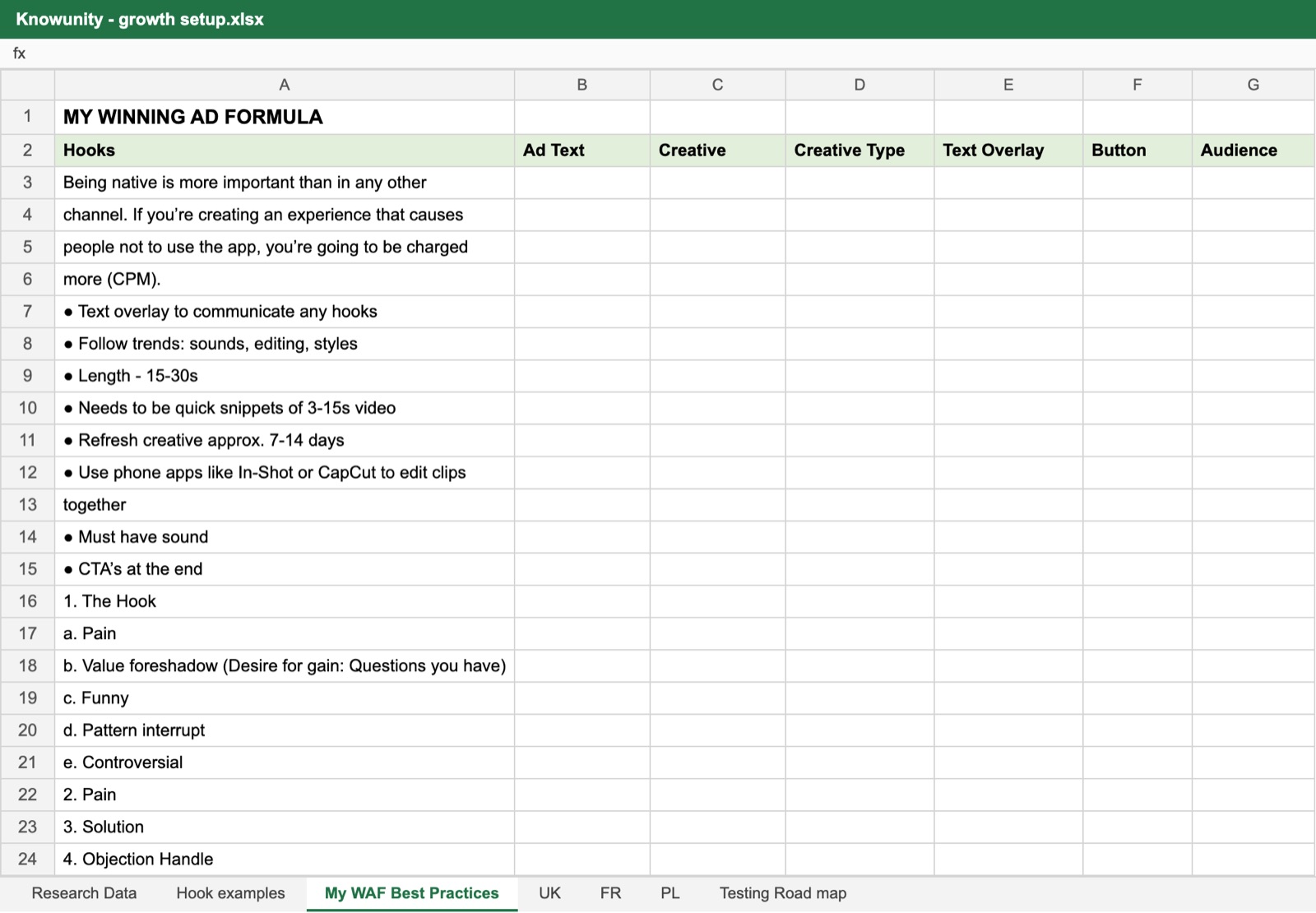
That balance between having a clear strategy and giving creators creative freedom was important.
We knew what message we wanted to test. They knew how to make it sound natural to their audience.
How we used Spark Ads to scale winning content
The next challenge was figuring out which videos deserved more budget.
We didn’t want to spend money boosting every video a creator published.
So we built a process around organic performance and paid amplification.
Each creator published content on their own TikTok account.
They also had a unique tracking link in their bio, which allowed us to attribute traffic and installs back to individual creators and content versions.
Our naming structure included the creator’s name, the month, and a version number.
It wasn’t complicated, but it helped us understand what was working.
Creators also shared their TikTok authorization codes with us.
These allowed us to run their original posts as Spark Ads.
For anyone unfamiliar with Spark Ads, they let you promote an existing TikTok post rather than uploading it as a separate brand advertisement.
The video still appears under the creator’s account, with the original engagement attached.
That was useful for us because we wanted to amplify content that already felt native to TikTok.
But we didn’t immediately put money behind every post.
We gave videos time to generate organic signals first.
If a video was showing promise, we considered boosting it. If it wasn’t, we moved on.
To help prioritize videos, we used a simple internal scoring method based on impressions multiplied by clicks.
It wasn’t a perfect measure of creative quality, and we didn’t treat it as one.
But it helped us quickly identify videos that were getting distribution and generating interest.
From there, we looked at the metrics that mattered more to us: installs and cost per install.
A video with impressive organic engagement wasn’t automatically a winner.
It still needed to bring students into the app at a reasonable cost.
A lot of our experiments didn’t work
I think this part is worth sharing because growth stories often focus on the experiments that worked.
In reality, we tested plenty of ideas that didn’t produce meaningful improvements.
And documenting those failures was just as important as documenting the wins.
We kept a record of the experiments so that teams in other markets didn’t have to repeat the same tests without a good reason.
Here are a few examples.
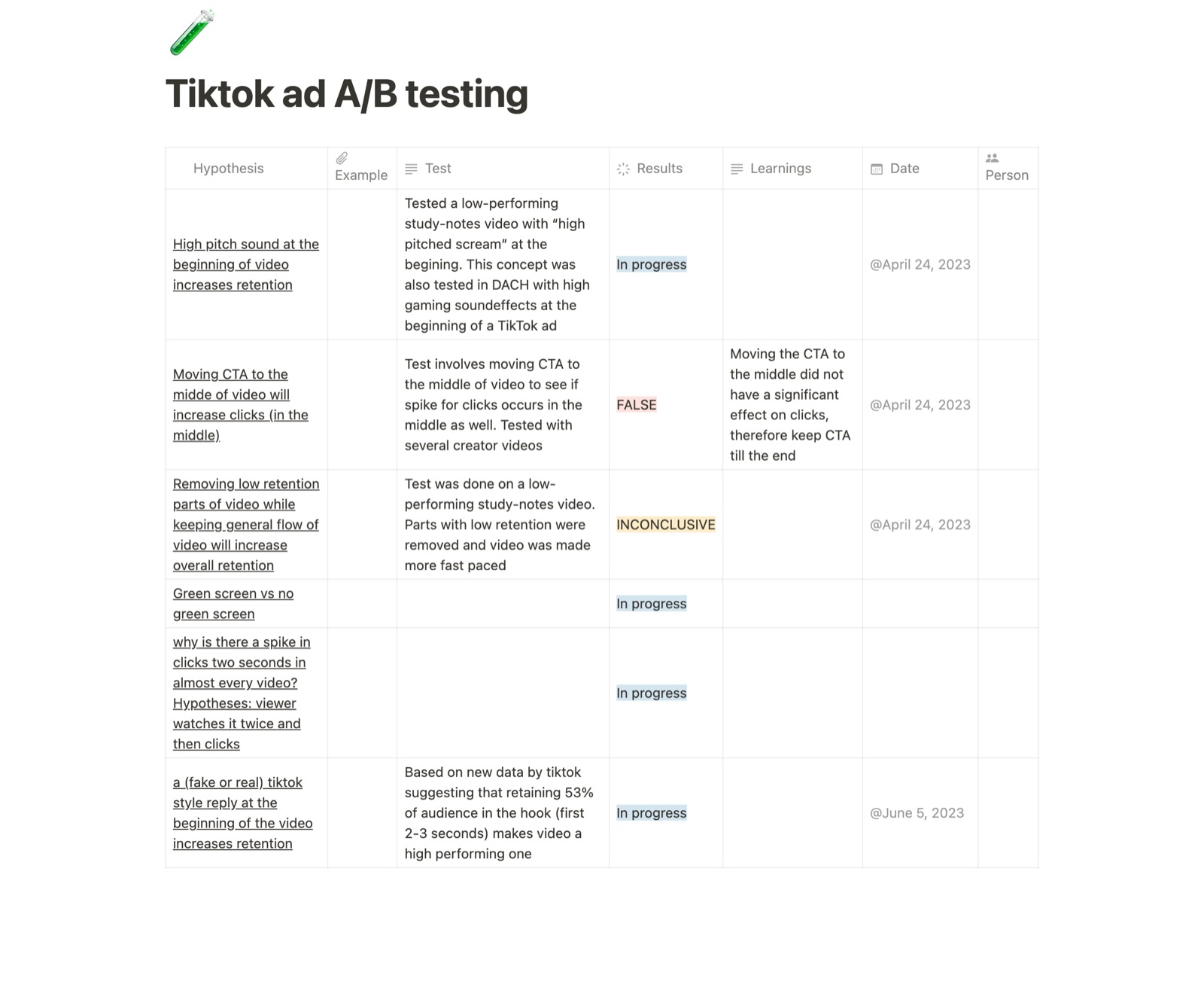
Moving the CTA into the middle of videos
We noticed that some videos had spikes in clicks around the middle.
That made us wonder whether we were leaving potential conversions on the table by waiting until the end to ask people to download.
So we tested moving the call to action earlier.
It didn’t make a meaningful difference.
We kept the CTA at the end.
Making videos shorter and faster
We took an underperforming video, identified where viewers were dropping off, and removed sections to make it more direct.
The idea was simple: less unnecessary content should mean better retention.
But the results were inconclusive.
Using sounds to stop the scroll
We experimented with loud sounds in the opening seconds of videos.
In Germany, we also tested gaming sound effects.
We tried opening videos with fake replies to comments, a format that was already familiar to TikTok users.
The thinking behind these experiments was that the first few seconds were critical to getting someone to continue watching.
Some variations showed promise, but we didn’t find a universal trick that worked across every market.
And that’s probably the point.
There wasn’t one hook, editing technique, or format that guaranteed performance.
We had to keep testing.
Sometimes the smaller improvements mattered too
Not every growth experiment involved TikTok.
In the UK, we also looked at how students were discovering Knowunity through the Google Play Store.
We updated our app description to include more of the keywords students were using when searching for study and revision resources.
The result?
Keyword visibility increased by 123%.
Organic installs increased by 3%.
Not exactly the kind of result that makes for an exciting growth headline.
But it was an improvement that required relatively little effort or additional spend.
And when you’re trying to grow across multiple markets, those smaller improvements add up.
Taking what we learned into the US market
When we started preparing for the US, we used the same research-led approach.
But we ran into a different problem.
Knowunity was a platform where students could discover and share study notes.
For that to work in a new market, you need students contributing notes in the first place.
And at the time, we didn’t have enough American study material on the platform.
So pushing downloads immediately wasn’t necessarily the right starting point.
We needed to build the supply side first.
Our initial US creator campaigns focused on encouraging students to upload their notes and earn money from their contributions.
It was a different message from what had worked in the UK.
We started with a small test in New York, using a limited budget to understand which messages resonated.
Once we identified the stronger approach, we expanded the campaign nationally.
That experience reinforced why we couldn’t simply copy a successful campaign from one market and expect it to work everywhere.
The process could stay the same.
But the problem we were solving, and therefore the message, had to reflect what was happening in each market.
What TikTok’s own creative playbook reinforced
Looking back, a lot of what we learned through experimentation aligned with TikTok’s own creative guidance.
TikTok’s Creative Codes framework covers six areas: TikTok First, Trends, Production, Structure, Stimulation, and Sounds.
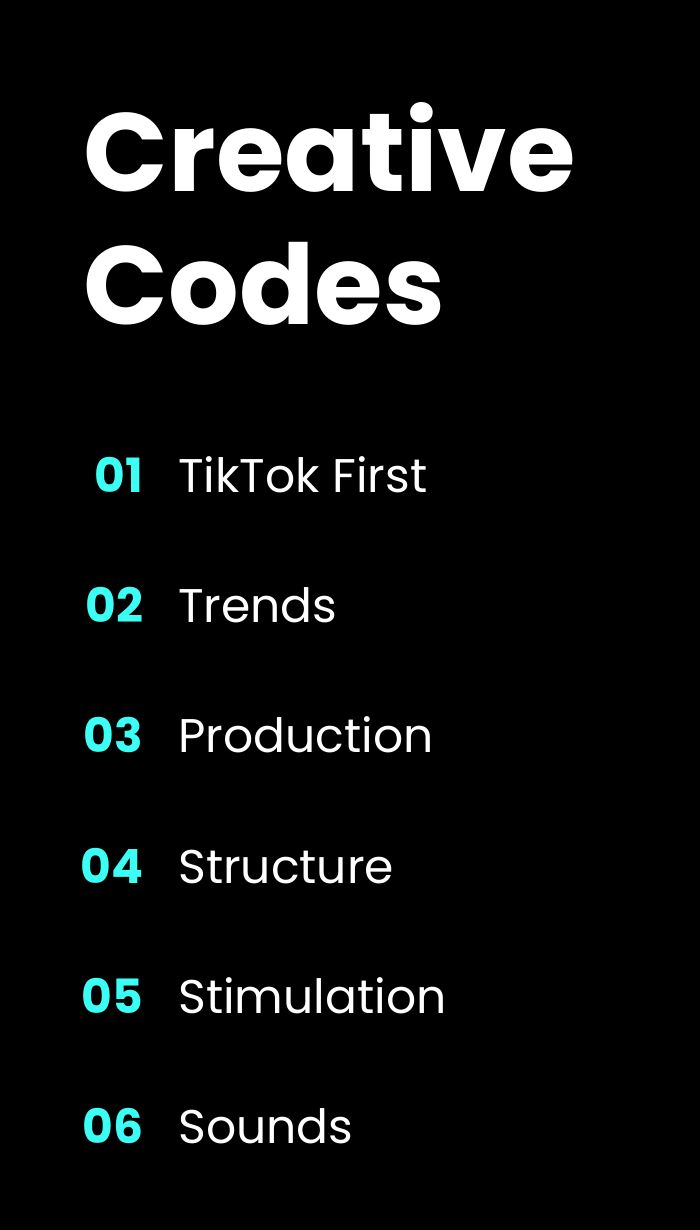
For us, the most important was probably TikTok First.
Our strongest videos looked and sounded like content students would normally post.
They weren’t polished brand commercials.
They were students sharing useful information, telling stories, or talking about school.
TikTok also emphasizes giving creators clear briefs while allowing them to communicate in their own style.
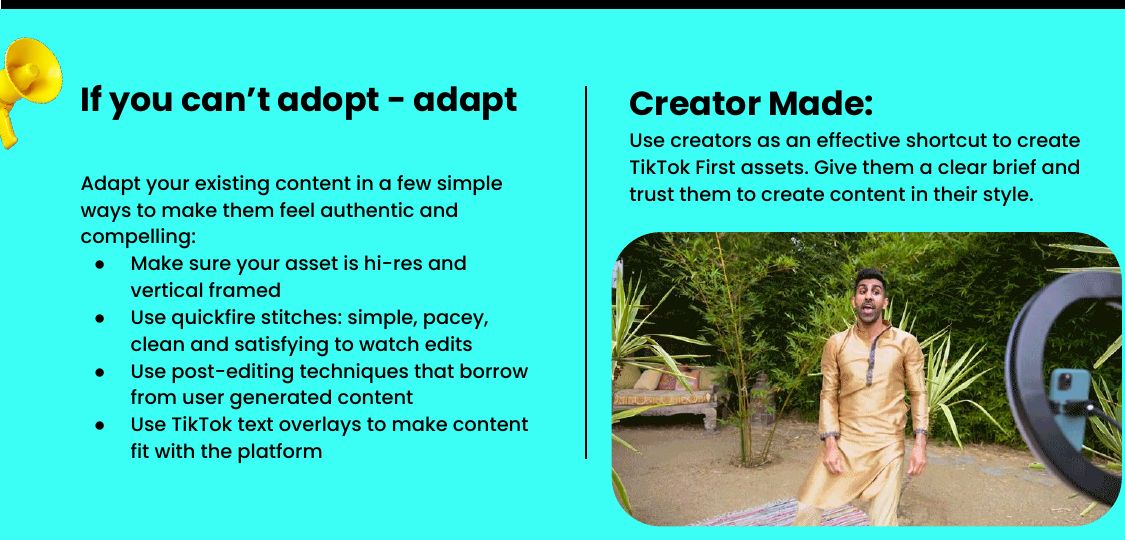
That matched our experience with over-scripted content.
And its guidance around the opening seconds of a video reinforced why we spent so much time experimenting with hooks.
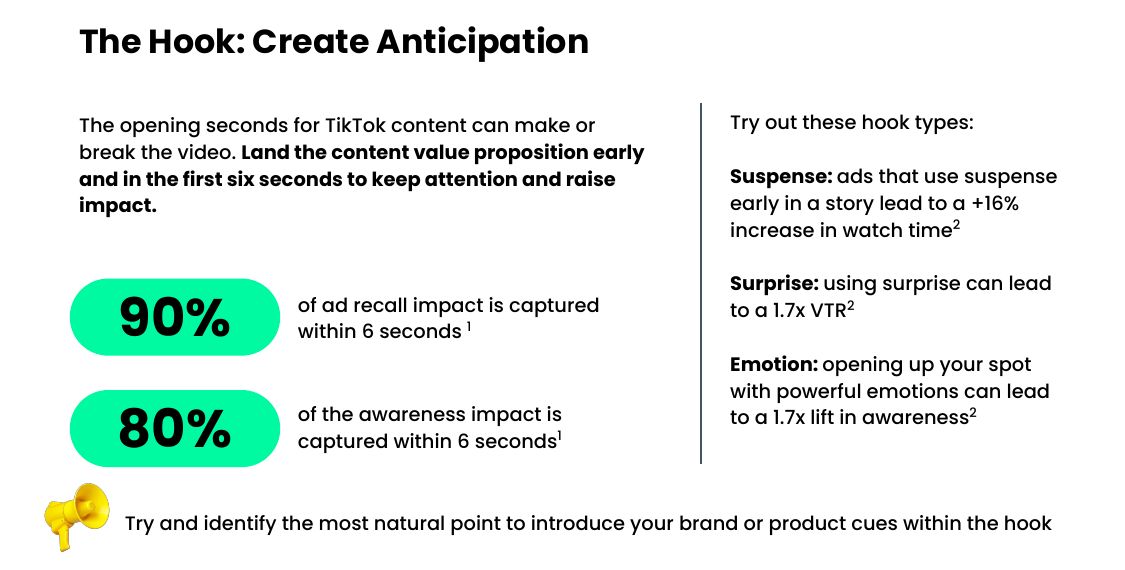
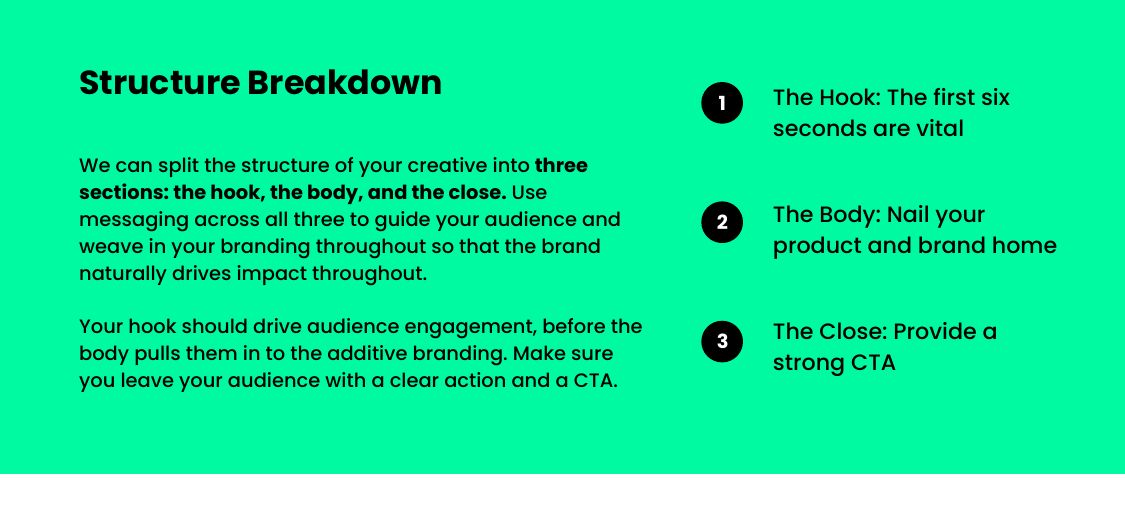
We weren’t always successful, but having a structured way to test these ideas made the process much more useful.
For anyone building a TikTok creator program, these are useful resources:
- TikTok Creative Center — for researching creative formats, trends, and high-performing ads.
- TikTok Creative Codes — for understanding the principles behind TikTok-native advertising.
- TikTok Creative Playbook for Small Businesses — for practical ideas on video structure and creative production.
The biggest lesson I took away
When I look back at my time working on Knowunity’s growth, I think about how much attention we gave to getting students to download the app.
We spent a lot of time understanding acquisition.
Which messages worked? Which creators performed best? Which videos deserved more budget? How could we bring down our cost per install?
And to be fair, we got pretty good at answering those questions.
But there was one area I wish I had spent more time on.
What happened after students downloaded the app?
Were they finding the notes they needed?
Were they coming back?
Were they actually getting value from the product?
I was so focused on driving installs that I didn’t spend nearly enough time understanding what happened afterwards.
And the irony is that the insight that helped us unlock growth in the UK came from students who had already downloaded the app.
Their reviews told us exactly what they needed.
We just had to pay attention.
That’s probably the biggest lesson I took from the whole experience.
Sometimes the most useful growth insights aren’t hiding in a new channel, a clever creative format, or another marketing tool.
They’re already sitting in the feedback from people using your product.
You just need to spend enough time listening.
I write these on Okey’s Notes, my Substack. Subscribe to get the next one by email.