A customer found us through AI. They’d never heard of us before.
What our Google and AI data shows about how B2B buyers find vendors now
November 2026
Last week a colleague posted in our team chat. A new customer had signed a deal 10 days after filling in our contact form. They had never heard of us before. When I dug into the source, they had found us through ChatGPT.
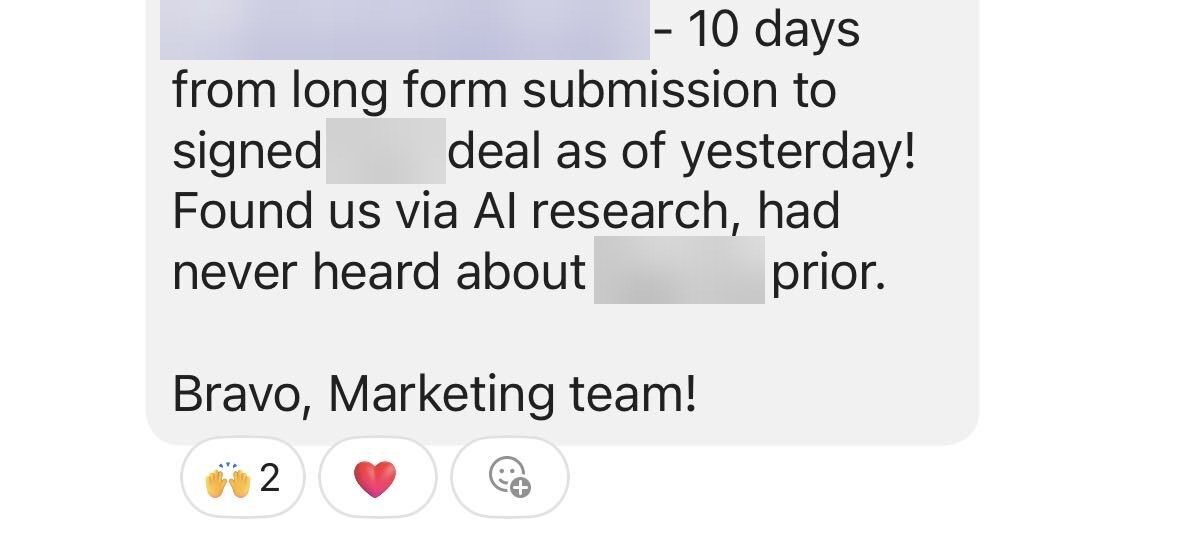
That stuck with me. Not because one deal changes everything, but because it matches something I’ve been watching in our data for a while.
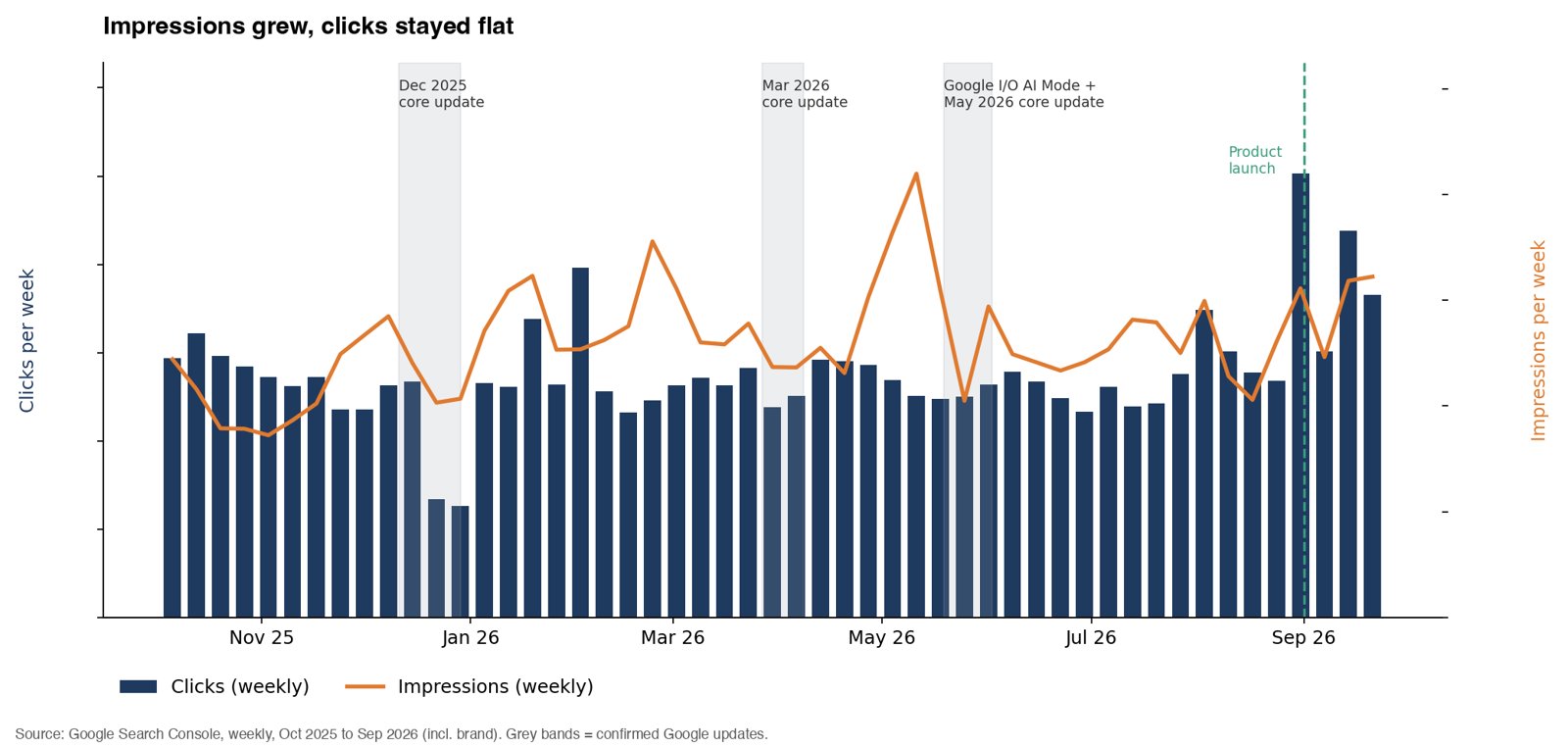
More people see us on Google. Fewer click.
Google has always been one of our biggest sources of traffic. Like most B2B companies, we write content around the questions our buyers search for.
Over the past year, our search impressions kept going up. Our clicks didn’t.
A big reason is Google’s AI Overviews. You used to search, click a website and read the answer. Now Google often writes the answer for you, right on the results page. You get what you need without visiting anyone’s site.
So your content still shows up. It just doesn’t bring people to you the way it used to.
When I split it by search type, the picture got clearer.
Searches for our brand name are only 17% of our impressions, but they bring 89% of our clicks. Searches about the problems we solve are 83% of impressions, but only 11% of clicks.
When people search for us by name, about 1 in 7 click (14.4%). When they search for the problem, it’s about 1 in 250 (0.4%).
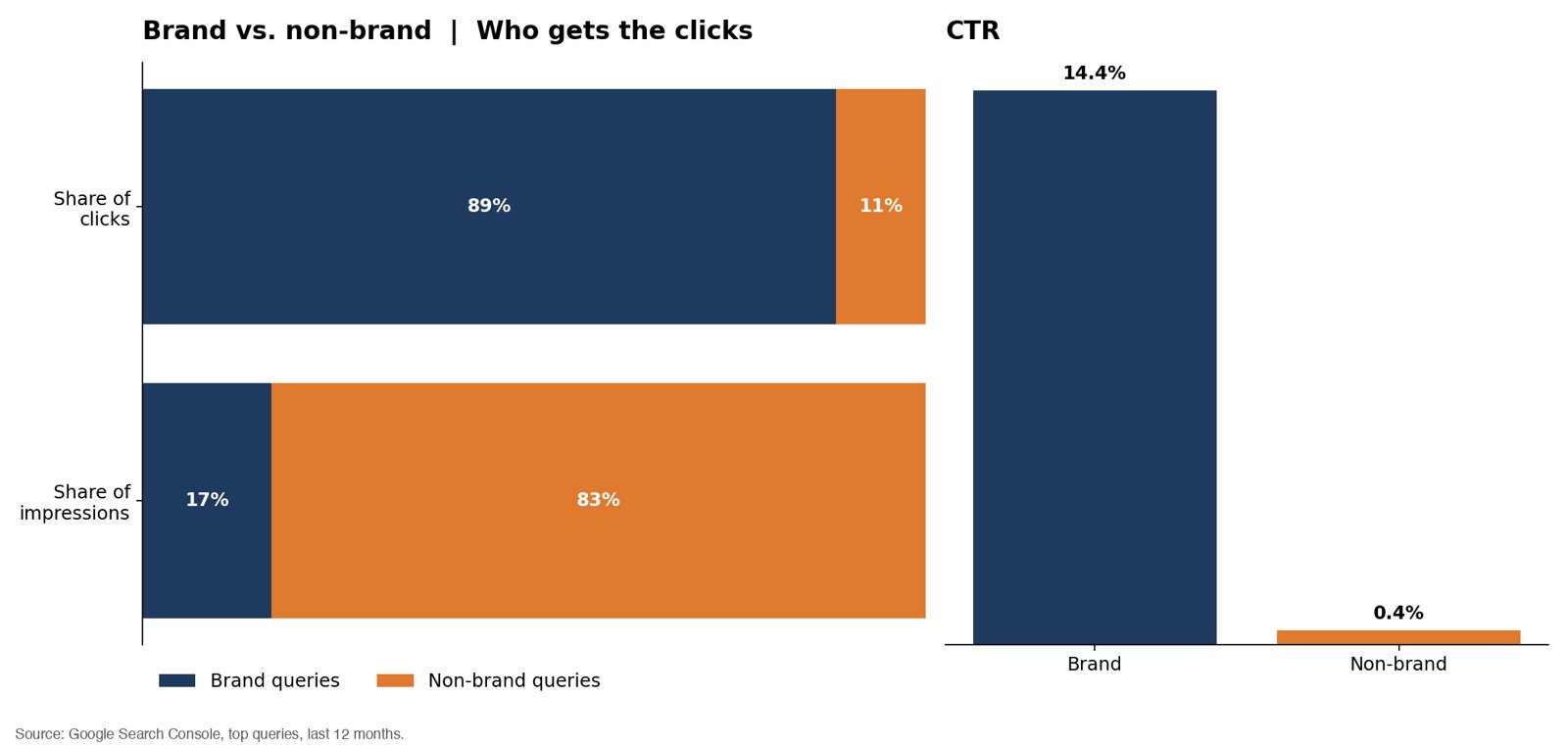
Non-brand searches always get fewer clicks. That’s normal. But this gap shows where the risk is. The people who don’t know us yet are exactly the people an AI answer can satisfy on the results page. If AI answers their question without mentioning us, we never meet them.
Then AI started sending us customers
While Google clicks stayed flat, a new source started showing up in our reports: AI tools like ChatGPT.
The deal above is the clearest example yet. This wasn’t someone reading a blog post. It was a buyer who didn’t know we existed, asked ChatGPT for help, found us and signed in 10 days.
That made me want to understand how buyers actually use these tools.
AI is changing who makes the shortlist
Kevin Indig published a study on Growth Memo last week. It looked at how 200 software buyers used AI when choosing a product.
One result stood out. Most buyers already had a few vendors in mind before they asked AI. But 62.7% of them came out of the conversation with a new vendor on their list.
For buyers who started with no vendors in mind, it was even higher: 82.5%.
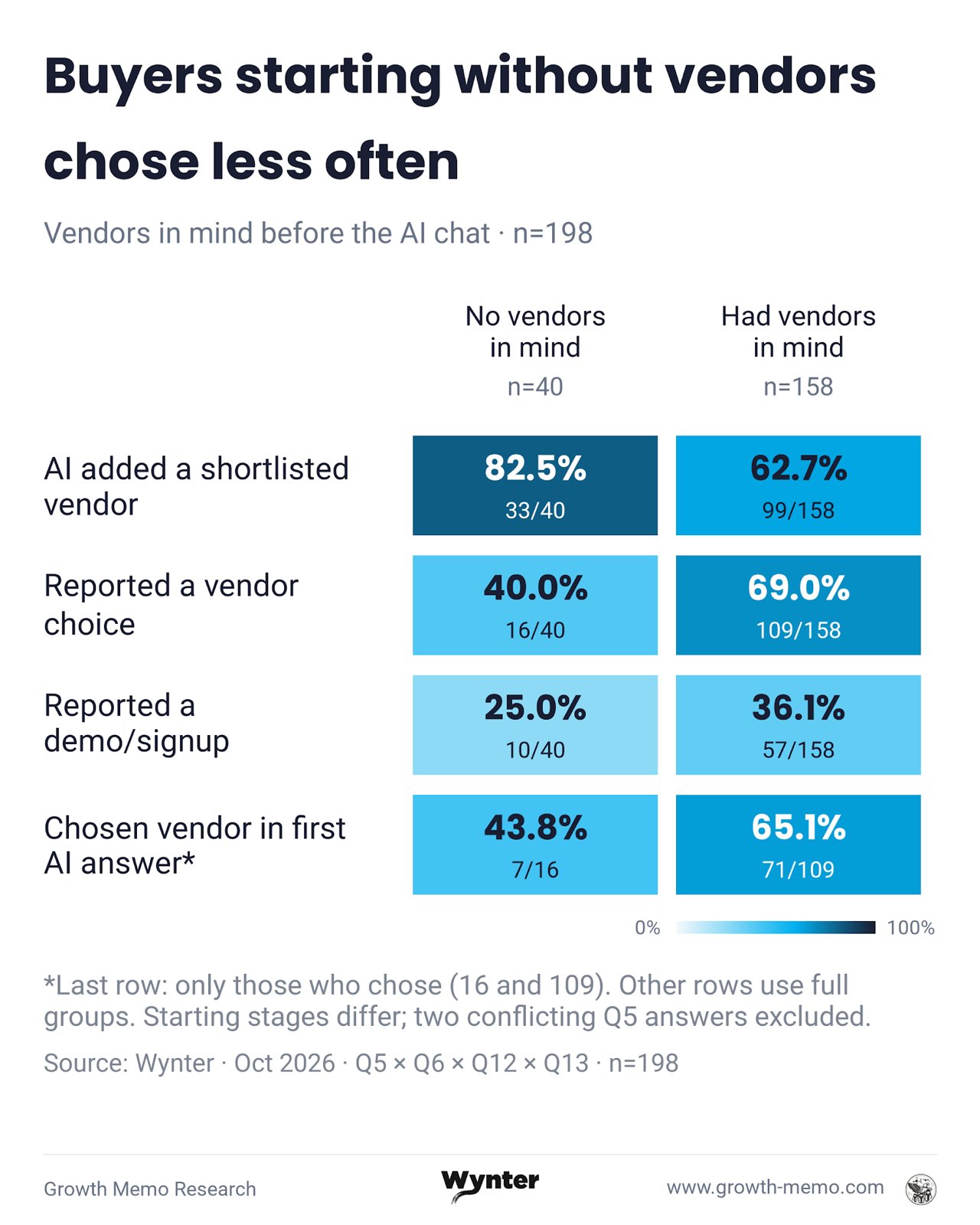
In plain terms: the shortlist isn’t fixed anymore. A buyer can walk in with two names and walk out with three. If you’re the third name, AI put you there. If you’re not, you might never know you lost the deal.
AI doesn’t replace Google. It comes first.
What did buyers do after talking to AI?
- 72.5% visited vendor websites
- 48% searched on Google
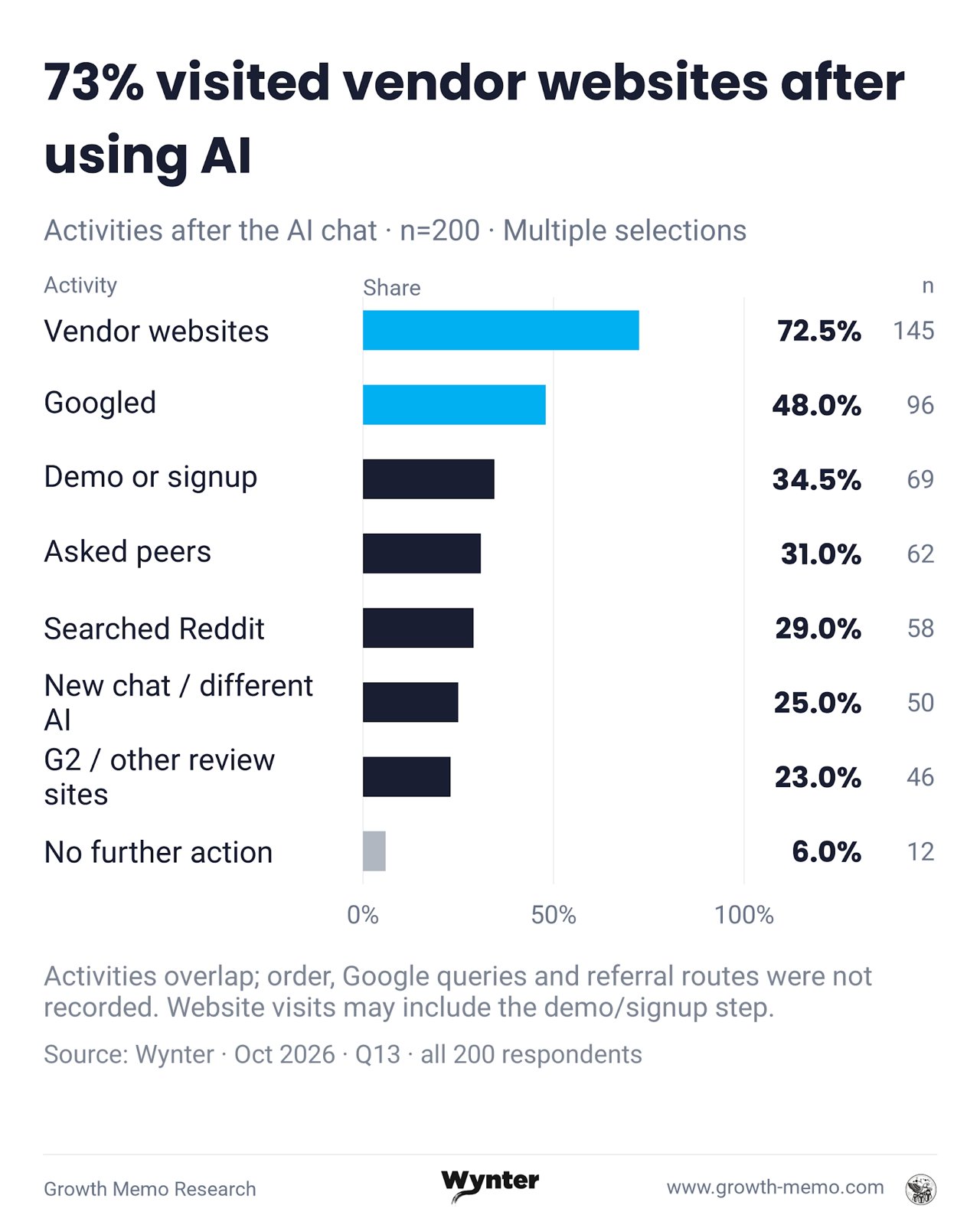
This matters for SEO. For years we’ve planned content around what people type into Google. But now some of the research happens before that, inside a chat. By the time a buyer searches, they may already know which names to search for.
Which AI your buyers use depends on who they are
Here’s where our data looks different from Kevin’s.
In his study, Claude was the most used AI tool for vendor research. 71% of buyers used it, ahead of ChatGPT at 62.5% and Gemini at 38.5%.
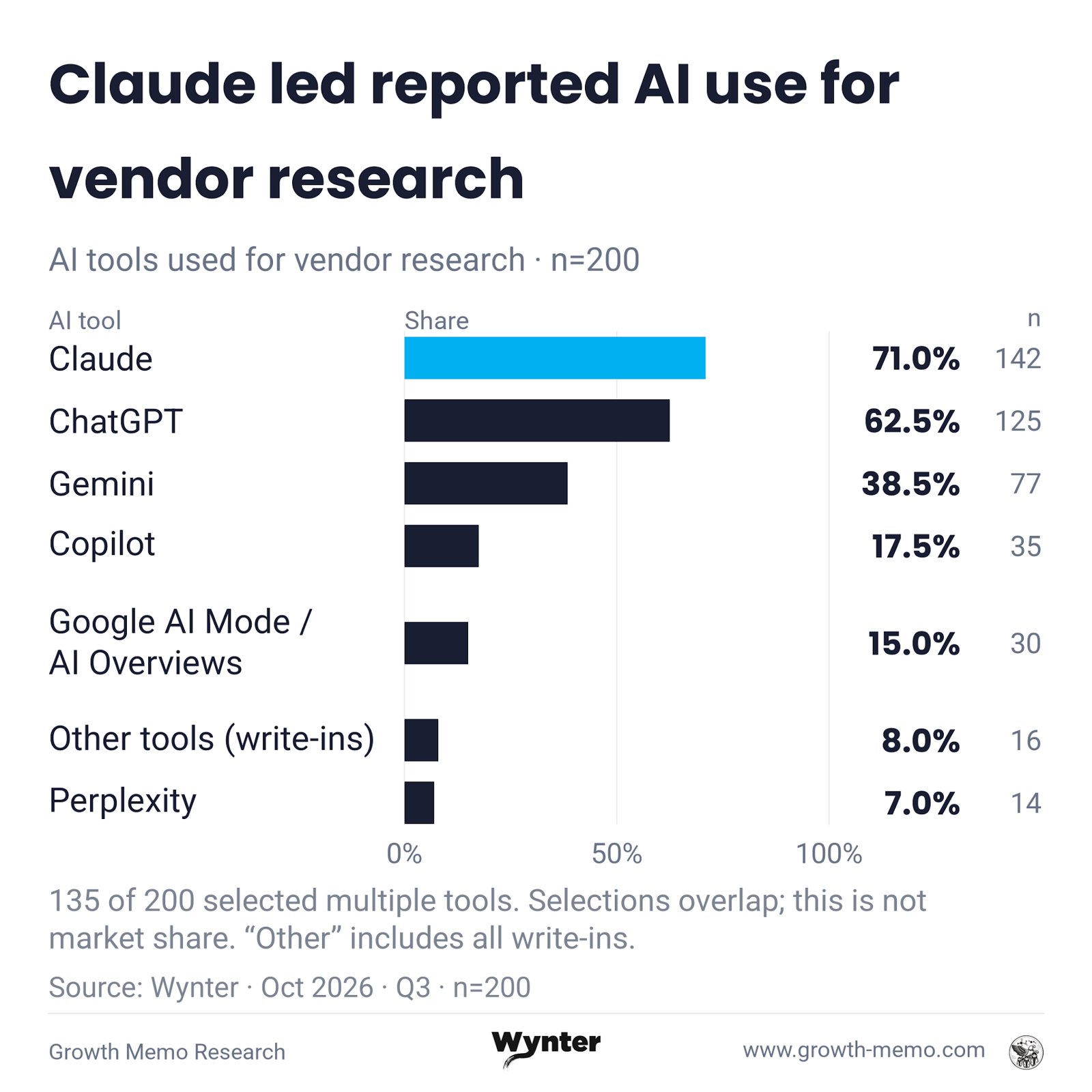
Our split is the other way round. Of the deals we can trace back to AI, about 70% came through ChatGPT and 30% through Claude. None came through Gemini.
The two numbers don’t measure exactly the same thing. Kevin asked buyers which tools they used, and many used more than one. We’re looking at which AI tool our actual deals came through. But the gap is still telling.
Kevin’s buyers all work in software. Software people use Claude a lot. Our buyers aren’t typical SaaS buyers, and they reach for ChatGPT first.
So there’s no single “AI channel” to optimise for. Before you decide where to focus, check which AI tools your own deals came through. Your buyers might not look like the buyers in the study.
Two kinds of AI buyers
The buyers using AI aren’t all doing the same thing.
The first buyer doesn’t know who to pick. They ask something like “What’s the best software for managing field teams?” AI suggests a few vendors. They ask follow-up questions about price, features and integrations, then visit the sites of the ones that sound right.
The second buyer already knows the options. They ask “Compare Vendor A and Vendor B for a team of 50.” They’re not looking for new names. They want help deciding.
These are two different problems. The first buyer needs to find you. The second needs enough clear, honest information to choose you.
What this means for our content
Keywords still matter. But I’ve started asking new questions:
- When someone asks AI for the best options in our category, do we show up?
- When they compare us to a competitor, is what AI says about us correct?
- Does AI know which problems we’re best at solving?
- Where is AI getting its information about us?
For being found, the work is about covering the problems and use cases buyers describe, not just the keywords they type.
For being chosen, it’s about making sure clear facts exist in places AI reads: what the product does, what it integrates with, what it’s not good for, and what customers say about it.
It’s not about writing more. It’s about making sure the right information exists where buyers and AI look for it.
How we’re tracking it
We’re now building our AI strategy around these questions, and you can’t improve what you can’t see.
So we use Peec AI. It runs the questions our buyers ask through AI tools every day and shows us three things:
- how often we come up in the answers
- where we appear compared to our competitors
- how AI describes us when it does mention us
That turns “are we showing up in AI?” from a guess into a number we can track week by week, the same way we’ve always tracked rankings on Google.
We’re still figuring this out
I don’t think SEO is going away, and I don’t think AI will replace Google. But buyers now move between AI, Google and vendor websites in a different order than they used to.
Rising impressions, flat clicks, a ChatGPT-heavy mix of AI-sourced deals and our first deal from a buyer who found us through ChatGPT made this impossible to ignore.
The question used to be “can people find us on Google?” Now it’s also “do we come up when a buyer asks AI who to consider?”
We’ve just started working with the YOYABA Organic Growth team to see how we can take this further and scale it.
I’ll share what we learn as we test it.
Research: Kevin Indig, “How software buyers use AI”, Growth Memo, 9 November 2026. Survey data from Wynter: 200 software buyers, self-reported.
This post is also on Substack, if you want to comment or share it. I write these on Okey’s Notes. Subscribe to get the next one by email.